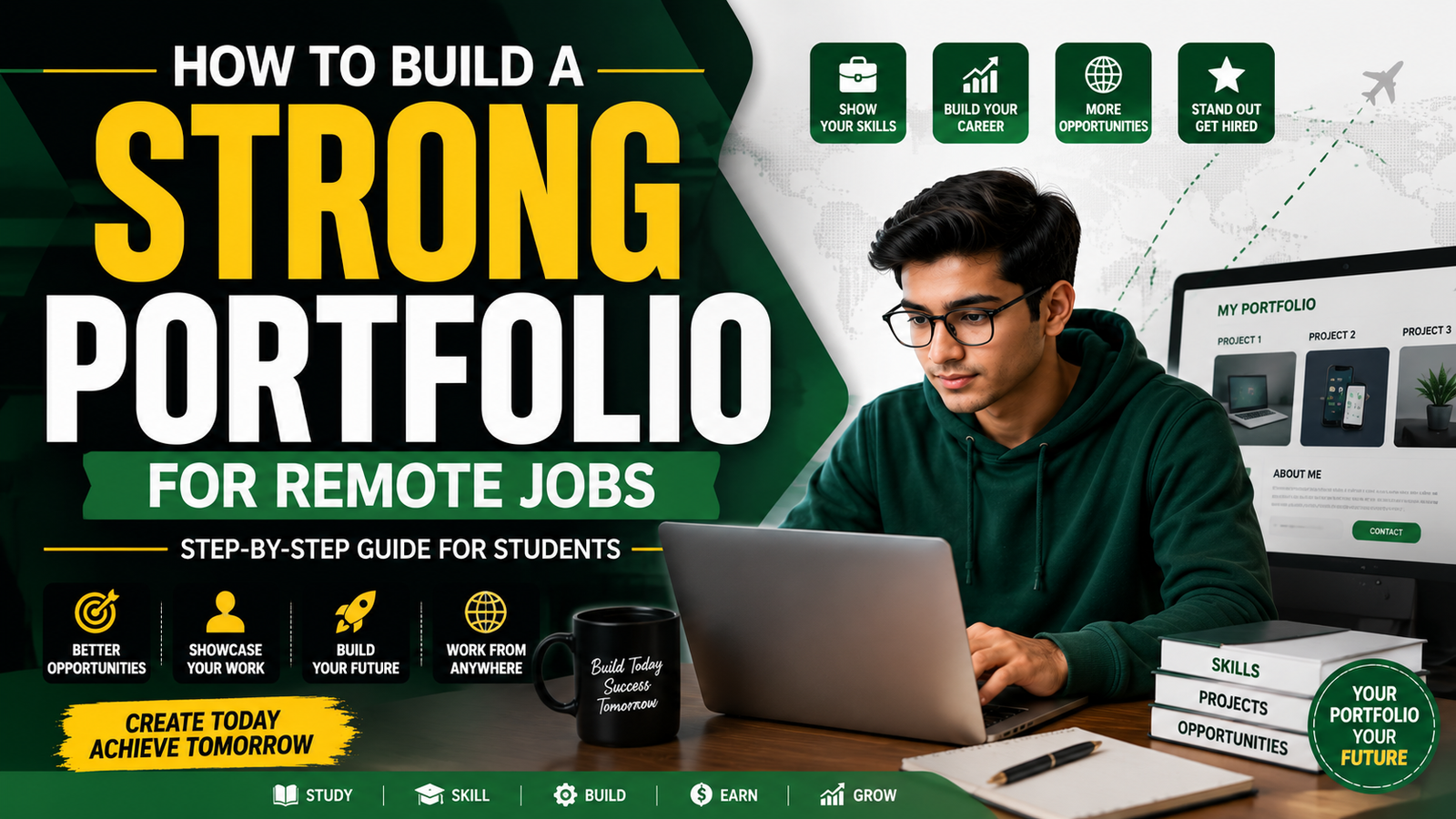
How to Build a Strong Portfolio for Remote Jobs: Step-by-Step Guide for Students
A strong portfolio for remote jobs can help you show employers what you can actually do, even if you have little or no formal work experience.
For students and beginners, a portfolio can turn an application from a simple list of claimed skills into visible evidence of practical ability.
When employers hire remotely, they may never meet you in person before deciding whether to interview you. Your CV explains your education and background, but your portfolio can provide direct examples of your work.
This is particularly useful for digital careers such as content writing, social media management, graphic design, WordPress development, video editing, SEO, virtual assistance, and other remote roles.
If you are still deciding which remote career is right for you, start with our guide to remote jobs for students in Pakistan .
A strong remote-job portfolio should include a short professional introduction, relevant skills, three to five strong projects, a clear explanation of your role in each project, genuine results where available, and an easy way for employers to contact you.
Table of Contents
- Why a Portfolio Matters for Remote Jobs
- What to Include in a Strong Portfolio
- How to Build Your Portfolio Step by Step
- Portfolio Examples for Different Skills
- How to Build Projects Without Experience
- Tools You Can Use
- How to Display Your Portfolio Online
- Common Portfolio Mistakes to Avoid
- How to Keep Your Portfolio Updated
- How to Share Your Portfolio With Employers
- Frequently Asked Questions
Why a Portfolio Matters for Remote Jobs
A CV tells an employer that you have a skill. A portfolio helps provide evidence that you have actually used that skill in a real or realistic project.
This becomes especially important for students and beginners. If two candidates apply for the same position and one provides relevant project examples, the employer has more information available when evaluating that candidate.
- It demonstrates practical skills.
- It can increase employer confidence.
- It helps you stand out from other beginners.
- It gives interviewers specific work to discuss.
- It documents your professional growth over time.
What Should a Strong Remote Job Portfolio Include?
Professional Introduction
Briefly explain who you are, what you do, and which type of remote role you are pursuing.
Relevant Skills
Highlight skills that directly relate to the jobs you want rather than listing every tool you know.
Your Best Projects
Select a small number of polished and relevant projects that demonstrate your strongest work.
Project Explanation
Explain the objective, your role, the process you followed, and the final outcome.
Results
Where genuine measurable outcomes exist, include them and clearly explain how they were measured.
Contact Information
Give legitimate employers an easy professional way to contact you.
How to Build a Portfolio for Remote Jobs Step by Step
Choose Your Career Direction
Avoid creating a random portfolio full of unrelated work. First decide which type of job you want.
For example, a WordPress portfolio should focus on websites and technical projects, while a content-writing portfolio should focus on written work.
Identify the Skills Employers Need
Review genuine job descriptions in your target field and identify the skills and responsibilities that appear repeatedly.
Create Practical Projects
You do not have to wait for someone to hire you before building evidence of your skills. Create realistic projects that resemble the type of work employers expect.
Select Your Strongest Work
Quality usually matters more than quantity. A few excellent projects are more useful than dozens of weak or unfinished examples.
Explain Each Project Clearly
Do not simply upload screenshots. Explain the problem, your process, the tools you used, and what you achieved or learned.
Publish Your Portfolio Online
Make your portfolio easy to access from your CV, application, email, or professional profile.
Portfolio Examples for Different Remote Job Skills
Content Writing Portfolio
- Three to five high-quality blog articles
- A landing-page writing sample
- A product description
- An email campaign example
- A short explanation of your research and editing process
Social Media Management Portfolio
- 30-day content calendar
- Sample captions
- Campaign strategy
- Social media graphics
- Example performance report
WordPress Developer Portfolio
- Business website
- Blog website
- Landing page
- Mobile-responsive layouts
- Performance optimization case study
Graphic Design Portfolio
- Brand identity project
- Social media campaign
- Advertising creatives
- Presentation design
- Website graphics
Video Editing Portfolio
- Short-form social video
- YouTube-style long-form edit
- Advertisement
- Interview edit
- Before-and-after editing example
SEO Portfolio
- Keyword research example
- On-page optimization project
- Internal-linking strategy
- Technical SEO checklist
- Performance report where genuine data is available
How to Build Portfolio Projects Without Job Experience
One of the biggest mistakes beginners make is assuming that they need a paid client before they can create a professional portfolio.
In many fields, you can create realistic demonstration projects yourself.
Always label fictional or demonstration projects honestly. Never claim that a sample project was completed for a real client if it was not.
Other legitimate portfolio sources can include:
- University projects
- Student societies
- Volunteer projects
- Personal websites
- Open-source projects
- Real work completed for a family business
You can also explore the SHJobNivo Portfolio and SHJobNivo Case Studies for examples of how professional work can be presented.
Tools You Can Use to Build a Portfolio
The right tool depends on your profession and the type of work you want to display.
Developers may prefer GitHub or a personal website. Designers may prefer visual platforms. Writers can use a professional website, blog, or organized online documents.
The platform itself is less important than the quality and relevance of your work.
How to Display Your Portfolio Online
Your portfolio should be easy to open, understand, and navigate.
- Use a clean professional layout.
- Keep navigation simple.
- Make sure it works on mobile devices.
- Compress large images where appropriate.
- Avoid unnecessary animations.
- Include professional contact information.
- Check that every portfolio link works.
Common Portfolio Mistakes to Avoid
Including Too Many Weak Projects
Your portfolio should showcase your strongest work rather than everything you have ever created.
Using Work That Is Not Yours
Never copy another person's project and present it as your own. This can immediately damage trust.
Showing Projects Without Context
Explain what you did and why instead of showing only a screenshot or final result.
Ignoring Mobile Visitors
Employers may open your portfolio on a phone. Test it on multiple screen sizes.
Leaving Out Contact Information
Make it easy for a legitimate employer to contact you professionally.
Never Updating Your Portfolio
Replace outdated beginner work as your skills and experience improve.
How Often Should You Update Your Portfolio?
There is no fixed schedule that works for everyone, but you should review your portfolio whenever your skills, experience, or career goals change significantly.
Consider updating your portfolio when:
- You finish a strong new project.
- You develop an important new skill.
- You achieve genuine measurable results.
- You begin targeting a different type of role.
- Old work no longer reflects your current ability.
Portfolio vs CV: What Is the Difference?
A CV summarizes your education, experience, skills, and professional background.
A portfolio shows practical examples of selected skills.
For many remote digital careers, the two work best together. Your CV provides context, while your portfolio gives employers evidence they can review.
Can a Strong Portfolio Help You Get a Remote Job Without Experience?
A portfolio cannot guarantee employment, but it can help solve one major problem faced by beginners: proving their ability when formal work history is limited.
Instead of simply saying “I can build websites,” you can show actual website projects. Instead of saying “I understand social media,” you can show a content strategy or campaign.
If you are starting your remote-career journey, also read:
Stay Safe When Sharing Your Portfolio
Your portfolio should help establish professional credibility, but avoid publishing unnecessary sensitive personal information.
Ready to Start Building Your Remote Career?
Build your skills, create strong projects, and explore opportunities that match your abilities and career goals.
Explore Career Opportunities Job ApplicationFrequently Asked Questions
Do I need paid clients to create a portfolio?
No. Students and beginners can use genuine university projects, personal projects, volunteer work, and clearly identified demonstration projects.
How many projects should I include in my portfolio?
There is no universal number, but three to five strong and relevant projects can be a useful starting point for beginners.
Can students create a professional portfolio?
Yes. Academic projects, independent work, internships, volunteering, and personal projects can all be used when they genuinely demonstrate relevant skills.
Do I need my own website for a portfolio?
Not necessarily. A personal website can look professional, but other platforms may work just as well depending on your profession.
Can a portfolio help me get a remote job without experience?
A portfolio cannot guarantee employment, but it can provide practical evidence of your skills when you have limited formal work experience.
Should every remote worker have the same type of portfolio?
No. The portfolio should match the profession. A developer, designer, writer, editor, and social media manager should showcase different types of projects.
Final Thoughts
Building a portfolio is one of the most useful steps students and beginners can take before applying for many types of remote jobs.
You do not need dozens of clients or years of experience to start. Choose a career direction, build relevant skills, create realistic projects, and present your strongest work professionally.
Your portfolio should make it easy for an employer to understand what you can do, how you work, and why your skills may be relevant to the role.
Continue learning through the SHJobNivo Blog, explore career opportunities, or learn more about SHJobNivo.